


Atlanta Travel
Девочки, наш друг ведёт вот такой полезный фото-блог, хочу порекомендовать гостям Атланты:
Что посмотреть в центре Атланты
Фото из Atlanta Travel :)

Девочки, наш друг ведёт вот такой полезный фото-блог, хочу порекомендовать гостям Атланты:
Что посмотреть в центре Атланты
Фото из Atlanta Travel :)
Миша - молодец :)

Feeling bored during your child's tea parties, block-building, or attempts to play Candyland? Of course you do sometimes. Playing with a preschooler can be tedious business for grown-ups. They're notoriously bossy, impetuous, and into doing the same thing again and again.
Don't feel bad about encouraging your child to play alone sometimes; it builds her independence. Also look for alternatives you can do together without losing your sanity, like or gardening, playing outside, or taking a walk. Or let your child imitate your activities while you work, for example, at her own "desk" or play kitchen.
Психологи убеждены: чтобы из мальчика вырастить настоящего мужчину, его надо меньше ругать и чаще хвалить.(Согласна!)
А большинство родителей делает наоборот. - Воспитать настоящего мужчину сложнее, чем вырастить настоящую женщину (Согласна!), - начала разговор доктор психологических наук Института психологии Елена Сергиенко. - Мальчики от природы более уязвимы, чем девочки.
К тому же понятие мужественности за последние десятилетия сильно изменилось.
Времена, когда считалось, что мужик должен быть могуч, вонюч и волосат, безвозвратно ушли.
Теперь нам нравится, чтобы молодой человек благоухал, щеголял не только прекрасным образованием, но и хорошим костюмом, был уверен в себе, умел ухаживать за дамой, прилично зарабатывал и при этом не считал унижением вымыть за собой тарелку.
Согласитесь, этот комплекс характеристик не вписывается в традиционное представление об истинно мужском воспитании, предполагающем четкое разделение на «мужское» и «женское». Однако в сближении обоих начал - успех взаимопонимания полов и адаптации ребенка в обществе.
Хорошо, если в семье, где растет малыш, работающие родители не делят домашние обязанности, а выполняют по принципу «кто сейчас свободен». При этом мама не забывает подчеркивать авторитет отца, а папа ежедневно играет с сыном в «рыцарство»: мол, «мы с тобой - мужчины, а мама - девочка».
СОВЕТЫ МАМАМ
Не скупитесь на ласку по отношению к маленькому сыну, не бойтесь вырастить неженку или пробудить раннюю сексуальность.
Наоборот: вы моделируете нормальные взаимоотношения между мужчиной и женщиной, в основе которых любовь.
А вот сына-подростка на колени к себе не сажайте. (Хахаха!!:))) Это и выглядит нелепо, и опасно для парня. В его возрасте сексуальность неуправляема, и может сформироваться неверная эротическая установка.
Не пренебрегайте мужественностью сына в любом его возрасте, разыгрывайте перед ним свою «слабость и беззащитность».
Даже годовалый джентльмен способен поднести маме книгу, пододвинуть стул. (мой Миша так трогательно заботится обо мне, когда я прихожу с работы, "сит даун, мам, сит", приносит ужин, приготовленный папой "ит, мама", чай)
Было бы ошибкой требовать от мальчика беспрекословного послушания и аккуратности.
Мальчишки входят в этот мир, чтобы его изменить. Тут уж не до белой рубашки. Но для этого юному «революционеру» надо уметь проявлять инициативу и отстаивать свое мнение.
Не опекайте чересчур. Пусть парень трогает горячее, носится сломя голову, семь раз отрезает и прочие безобразия хулиганит.
Не браните за все подряд.
Если в доме одни женщины, отдайте мальчугана в спортивную секцию или кружок, где занятия ведет мужчина. У ребенка перед глазами должен быть тип мужского поведения, чтобы в будущем парень «не вел себя как баба».
ИНТЕРЕСНЫЕ ФАКТЫ
Мальчиков в 4 раза чаще наказывают, чем девочек, и в 2 раза меньше хвалят.
Среди мальчишек вдвое больше невротиков.
Самооценка у мальчиков значительно ниже, чем у девочек. Хотя ребята от природы требовательнее к себе, чем их ровесницы. Дело в том, что душа мальчишки каждый день жаждет подвига. И, если не удается сразу отжаться пять раз, паренек начинает плохо о себе думать.
Неполные семьи сильнее «бьют» по мальчикам. Мальчишки, выросшие без матери или без отца, чувствуют себя одинокими, беззащитными, агрессивными гораздо чаще, чем девочки в такой же ситуации. Среди малолетних преступников 95% - мальчики, которых воспитывала одна мама.
(По данным Института возрастной физиологии детей и подростков РАО.)
СОВЕТЫ ПАПАМ
Не стыдите маленького сына за слезы.
Настоящая мужественность воспитывается иначе. Например, если вы вместе принесете с рынка картошки (три картофелины и карапуз дотащит), или вдвоем вобьете нужный гвоздь в стену, или на пару займетесь спортом.
Не говорите на языке силы, «как мужчина с мужчиной», не применяйте физические наказания. Насилие чревато озлобленностью. А лучше пойдите с чадом на птичий рынок и купите щенка (рыбок, черепаху - все равно кого), чтобы ваш «сильный» сын ухаживал за кем-то «слабым».
Чаще хвалите наследника. Кто, как не отец, должен своевременно проинформировать взрослеющего сына о том, что у женщин обоняние острее, чем у мужчин, и предложить свою помощь в организации личной гигиены.
Марина АНИКЕЕВА (Источник: "Комсомольская правда")
by Alexi Wilbourn
Tots younger than 2 should not be exposed to the television.
That’s the message in a new study from the American Academy of Pediatrics.
The study found that speech development can be delayed when children younger than 2 watch or are placed in proximity of the TV, even when it is in the background.
The AAP was unable to identify any positive educational or developmental benefits when babies see or are within earshot of the TV.
The nudge to parents: Turn off the tube when little ones are in the room.
For every hour of TV exposure, the child younger than 2 spends 11 percent less time in creative play, according to the new study.
Unstructured, creative play is one of the most beneficial things for eveloping minds, especially when it involves parent-child interaction, according to the AAP.
Children older than 2 should be restricted to viewing no more than two hours of TV per day, according to the AAP.
“I would really advise both pediatricians and parents that there’s no real positive value to sitting in front of the TV,” says Dr. Jim Fortenberry, pediatrician-in-chief at Children’s Healthcare of Atlanta at Egelston. He agrees that TV exposure has no constructive effect for children 2 and younger – even if a program is considered educational.
“Those toddlers don’t understand contextually what the show is about,”
Fortenberry says. The “glowing box” serves as more of a distraction to infants and prevents them from connecting with other people in the room. TV is no substitute for the developmental needs that come from positive interaction with parents and siblings, Fortenberry adds.
Brookhaven mom Jennifer Hutcheson has kept her eye on the AAP guidelines for TV exposure to children. However, when daughter Lucy turned 15 months, Hutcheson decided to let her watch 15- to 30-minute segments a couple of times a week.
What changed this mom’s mind?
Like other parents, Hutcheson needs time to tend to daily tasks, such as preparing dinner. She tries to engage Lucy in activities such as “cooking” in her play kitchen, but sometimes a diversion is needed.
Now 19 months, Lucy is only allowed to watch Clifford the Big Red Dog and Curious George because they are commercial-free, have timely cuts between scenes, and teach positive values such as sharing and friendship.
The colorful images and lovable animals in these shows keep Lucy entertained.
Hutcheson says she never expects TV to provide a substitute for real learning.
Like candy and sugar, most things are OK in moderation, says Ormewood Park mom Gracie Gummere. TV is no exception, regardless of the updated AAP guidelines.
For every hour of TV exposure, the child younger than 2 spends 11 percent
less time in creative play.
“I think it’s ridiculous when people go to the extreme” whenever experts or
an organization release new guidelines, Gummere says.
Her oldest son, Ryland, 3, watches about an hour of TV every day, which falls within the recommended amount for his age group.
When he was younger, Ryland especially liked the show Yo Gabba Gabba! These days, he loves talking to his parents about his current favorite shows, which include Little Einsteins, The Backyardigans, WordWorld and Super Why. Ryland’s little brother Miles, 16 months, hardly glances at the TV, Gummere says. He’s mostly busy with toys and other activities.
Fortenberry’s advice: If you’re cooking, put the child in a safe setting, such as in a roller seat. Give them toys such as nesting cups that they can play with, and continue to interact with them, if possible. This plan allows the child to see you and vice versa, and your child remains engaged, both physically and mentally.
P.S.
До того, как Мише исполнился годик, я старалась оберегать его от телевизора, если он появлялся в комнате, где был включен телек, мы его сразу выключали.
После года стали показывать русские мультики (моего детства, и только добрые, без агрессии и страшилок), по 20-30(самое большое) минут.
После 2-х лет, конечно, всё иначе.
Жизнь не идеальна, мы с мужем очень заняты оба, добрые гномики по ночам не приходят и за нас домашнюю работу не делают, хотя мечтала бы об этом, так что иногда да, засаживаю Михал Потапыча перед "ящиком". Но стараюсь сама выбирать мультики, по возможности добрые, без "страшных" и уродливих (с квадратными, треугольными головами, и т.д.) персонажей, без драк и насилия.
После сада, пока готовим-разогреваем еду, смотрит образовательный канал для дошкольников "Sprouts", любит мультик про мальчика Каю, там описаны жизненные ситуации, как правильно поступать если...
Диснеевские сказки смотрим вместе по выходным, сама люблю.
Иногда русские, короче вперемешку :)
Стараюсь не дольше часа-полтора в день :)
What a day: Your 2-year-old starts the morning by screaming, "No, me do it!" when you pour the milk on her cereal. Then she flat-out refuses to put away any of the toys she's taken out. Later, when you've had about all you can take, your child has a full-fledged tantrum because she happens to be playing with her friends when you arrive to pick her up at daycare. Is this kid trying to drive you nuts?
The truth is, dealing with a defiant 2-year-old is a notoriously difficult part of childrearing. (They don't call it the "terrible twos" for nothing!) When your child shouts "No!" or hurls herself on the ground, kicking and screaming, it's no fun for you, but it is a normal reaction for a child this age.
Think about it: Your child is caught up in the excitement — and frustration — that comes with her budding autonomy. Maybe her baby brother gets more attention than she does, or maybe she doesn't like it when she's supposed to drop everything at your whim. Her challenging behavior may not always be appropriate, but it's to be expected at this age.
You may end up with a few gray hairs when it's all over, but you'll survive largely intact by trying to understand where your child is coming from — and by handling her stormy reactions with care.
Be understanding. When your child screams and cries because she doesn't want to leave the playground, give her a hug and tell her you know it's hard to go home when she's having so much fun. The idea is to show her that instead of being part of the problem, you're actually on her side. +1
Try not to get angry (even if you feel embarrassed in front of the other parents). Be kind but firm about making her leave when she must. + Это нелегко, но надо ;)
Set limits. Young children need — and even want — limits, so set them and make sure your 2-year-old knows what they are. Spell it out for her: "We don't hit. If you're angry, use your words to tell Adam that you want the toy back" or "Remember, you always have to hold my hand in the parking lot." + Точно, что делаю я, Вау :)
If your youngster has problems abiding by the rules (as every 2-year-old will), work on solutions. If she hits her baby brother because she's feeling left out, for instance, let her help you feed or bathe him, then find a way for her to have her own special time with you. If she gets out of bed because she's afraid of the dark, give her a flashlight to keep on her nightstand.
Reinforce good behavior. Rather than paying attention to your child only when she's misbehaving, try to catch her acting appropriately: "Thanks for playing with Charlie while I change his diaper. That's very helpful!"
And though you may be sorely tempted to give your child a verbal lashing when she engages in undesirable antics, hold your tongue. "When a child behaves badly, she already feels terrible," says Jane Nelsen, author of the Positive Discipline series of books. "Where did we ever get the idea that in order to make children do better, we first have to make them feel worse?" In fact, doing so may only produce more negative behavior.
Remember, too, that disciplining your child doesn't mean controlling her — it means teaching her to control herself. Punishment might get her to behave, but only because she's afraid not to. It's best for your 2-year-old to do the right thing because she wants to — because it makes the day more fun for her or makes her feel good.
Use time-outs — positively. When your child is at the end of her rope, ready to bust a gasket because she isn't getting her way, help her cool off. Rather than a punitive time-out ("Go to your room!"), take her to a comfy sofa in the den or to a favorite corner of her bedroom. - Хахаха! Kак типично для америки :)
Maybe your child would even like to design a "calm-down place" for herself — with a big pillow, a soft blanket, and a few favorite books. If she refuses to go, offer to go along with her and read a story.
If she still refuses, go yourself — just to chill out. You'll not only set a good example, you might get a much-needed break. Once you both feel better, that's the time to talk about appropriate behavior.
Empower your 2-year-old. Providing opportunities for your child to make her own choices allows her to try out some of her newfound autonomy in a controlled environment. Instead of demanding that she put on the jeans you've selected, for instance, let her choose one of the two pairs you've laid out. Ask if she'd like peas or green beans with dinner, and which of two stories at bedtime.
Another way to help your youngster feel more in control is to tell her what she can do instead of what she can't. Rather than saying, "No! Don't throw that ball in the house!" say, "Let's go outside and throw the ball together." If she wants an ice-cream cone before dinner, tell her she can choose between a slice of cheese and a banana. - Пытаюсь именно так и поступать :)
Choose your battles. If your fashion-savvy 2-year-old wants to wear her striped turtleneck with her pink, polka-dot leggings, what do you care? If she wants waffles for lunch and peanut butter and jelly for breakfast, what's the harm? Sometimes it's easier to look the other way — when she splashes in a mud puddle on the way home, for example, or stuffs her puppet under her bed instead of putting it on the proper shelf. -100% согласна!
Respect her age and stage. Try to avoid situations that are sure to send your 2-year-old into a meltdown. Why risk taking her to a fancy restaurant when you could just meet your sister for a picnic in the park? How realistic is it to expect your youngster to behave in a clothing store or sit quietly during an hour-long community meeting?
If you find yourself in a tricky situation, use distraction to avoid a head-on collision with your tot. When your child spots a lovely flower arrangement in the lobby, for instance, quickly show her how the numbers by the elevator shift as the elevator changes floors.
Finally, respect the unique world your 2-year-old lives in, especially the way she perceives time (or doesn't). So rather than expecting her to jump up from a game at daycare to rush home with you, give her a few minutes' notice to help her switch gears ("Amy, we'll leaving in five minutes, so please finish up").
There's no guarantee that your child will break away from her fun without complaint. (In fact, it's a good bet she'll raise the hairs on the back of your neck with her bellowing.) But as long as you're patient and consistent, your youngster will eventually learn that defiance isn't the way to get what she wants.
Будем дерзать!
СМИ.
Со вчерашнего дня американцы смотрят на сковородки с антипригарным покрытием со страхом: тефлон, знаменитый тефлон, который не дает котлете и мясу прилипнуть к сковороде, оказался опасен и будет запрещен. В ходе лабораторных экспериментов с животными, которым вводились большие дозы одного из компонентов покрытия, выяснилось, что эти вещества способствовали возникновению рака печени, низкому весу новорожденных, вызывали проблемы с иммунной системой и процессом развития.
Могущественное американское федеральное агентство по защите окружающей среды (EPA) наложило запрет на этот один из самых раскрученных промышленных продуктов, который нашел применение как в производстве кухонной утвари, так и в аэрокосмической и текстильной промышленности, в производстве сердечных клапанов, в электронике и изготовлении пакетов для поп-корна для микроволновых печей, и приносит немалые доходы. Производителям было заявлено о необходимости сократить на 95% производство кислоты Pfoa до 2010 года и затем до 2015 года планомерно завершить ее производство.
Американское агентство заявило, что будет продолжать исследовать влияние этого компонента на здоровье человека, чтобы понять, нужны ли дополнительные меры. "Наука изучает все качества Pfoa, но обеспокоенность существует, и поэтому свести к минимуму последствия использования этого вещества – совершенно справедливое решение и с точки зрения окружающей среды, и с точки зрения здоровья людей", – заявила Сьюзан Хейзен, заместитель руководителя отдела пестицидов EPA.
DuPont, одна из компаний, к которой было обращено требование, заявила о том, что исследования, проводившиеся ее специалистами и некоторыми независимыми учеными, свидетельствуют о том, что сковородки и другие предметы, сделанные из ее материалов, вполне надежны. Кроме того, подчеркнули в компании, до сих пор ничего не известно о пагубном влиянии Pfoa на здоровье людей и пока не удалось найти достойной замены этому химическому компоненту при производстве тефлона. "Мы ведем поиски в течение 30 лет, безуспешно". И все же восемь предприятий, использующих тефлон, сделали хорошие лица при плохой игре и согласились с программой: речь идет о 3M/Dyneon Arkema, AGC Chemicals/Asahi Glass, Ciba Specialty Chemicals, Clariant, Daikin и Solvay Solexis.
По мнению наблюдателей, данное решение агентства можно считать самым агрессивным с тех пор, как 15 лет назад оно наложило запрет на асбест. Все понимают, что вчерашнее заявление – в большей степени рекомендация, а не запрет. Вместе с тем, эксперты советуют: "Избавляйтесь от поцарапанных сковородок".
Я повыкидывала все тефлоновые сковородки.
Теперь у меня 3 - из нержавеющей стали и одна вот такая новая - Керамическая, вчера купила, сегодня уже завтрак на ней жарила :)
Такой не очень полезный, зато на очень полезной сковородке :)

Ceramic Star Frying Pan
Fast and efficient
Ideal for high-temperature, low-fat frying. Thanks to the innovative nanotechnology, the coating is environmentally friendly, extremely hard and resistant.
· 4.0mm aluminium pan
· Light and efficient
· Ceramic coating, heat-resistant up to 450 °C
· Green nanotechnology: 100% free of PTFE/PTFOA
· Outside: enamelled porcelain for a strengthened pan body
On the one hand, the ceramic coating is extremely heat resistant (up to 450 °C) and is therefore also well suited for quick browning, while, on the other hand, it also has an excellent anti-stick properties, which support a low-fat diet.
Does it really take longer to potty train boys than girls?
Yes, although no one, including expert T. Berry Brazelton, seems to know why. In her book Toilet Learning, Alison Mack says the difference may be partially due to the fact that moms are usually the primary potty-trainers in a family. Boys without a male role model to imitate in the bathroom may take a little longer to get the idea, while girls have the advantage of observing someone with the same equipment.
Правда, Маша в 1.5 уже ходила на горшок :)
Even if Dad is equally involved, boys sometimes need more time than girls, possibly because it's a two-step process for them. First they learn to pee and poop sitting down, then they have to master part of the act while standing up.
Что мы и делаем :)
If your son takes longer to train than the girls in his daycare, don't sweat it. Just be sure to watch for readiness signs and go from there.
Should my son pee standing up from the start?
Since bowel movements and urine tend to come out all at the same time, it makes sense to have your 2-year-old sit for both. This way, he learns that both pee and poop belong in the potty. Plus, the thrill of learning to aim and spray won't distract him from concentrating on mastering the basics.
When buying a potty chair for your son, look for one without a urine guard (or one you can remove). While such a shield might protect your bathroom linoleum from a few stray drops, it also can bump into and scrape your son's penis, causing him to associate going to the bathroom with pain.
How do I teach my son to pee standing up?
Once your child has mastered going to the bathroom sitting down, he can advance to trying the standing position. Having a readily available male role model is key. Arrange for your son to follow Dad, an uncle, or family friend to the bathroom to watch him in the act. When your son seems to understand how to do it, let him give it a go, perhaps into his own potty chair while standing next to the big toilet.
If he seems reluctant, try floating a few Cheerios or other small, flushable objects (some companies sell products just for this purpose) in the toilet bowl for target practice. Be prepared to do some cleanup around the toilet since it may take him some time to master the skill (practice makes perfect).
Купила "мишени" в виде самолетиков, машинок и мячиков :)
Swap stories and advice about potty training with other parents in the BabyCenter Community.
P.S. Заметен большой прогресс.
В садике просится "пати".
Дома через раз писает на горшок, а когда не успевает - расстраивается.
Думаю скоро :)
By Nicci Micco
It should have been simple. My mom wanted to buy my son Kai, then 4 months old, a teething toy. But standing in the baby toy aisle at Target, I was paralyzed by indecision. “This is cute,” she said, showing me a colorful ring of keys. “Tha tis cute,” I murmured, scanning the packaging for“BPA-free.” I’d read loads of stuff about bisphenol A (pronounced bis-FEEn-al A), or BPA, a chemical thatcould lead to cancer. It’s something my mom never had to worry about when she was raising me.
Today, moms are bombarded with so much information about all kinds of scary-sounding stuff from phthalates to pesticides. Like me, you may want to raise your baby “naturally” by limiting his exposure to chemicals. But you shouldn’t have to sweat every gift he receives from Grandma or take out a home equity loan to pay for all-organic grocery trips. So, where do you start? First, try not to become overwhelmed suggests Jennifer Taggart, author of Smart Mama’s Green Guide: Simple Steps to Reduce Your Child’s Toxic Chemical Exposure. “Trying to tackle reducing exposure to potentially harmful chemicals can seem to be a Herculean task,” says the mom of two. “Just take itone simple step at a time.” Start with these five steps: They’re pretty painless and their payback is big.
1 Green Your Clean
Even if you’re someone who might not think twice about what you use to clean your house, once your kid starts drinking his bathwater and licking the windows, you might begin questioning the use of harsh chemical cleaners, especially when you read the labels or note the childproof caps on the packaging. “There may be giant signs that say ‘warning’ or ‘danger,’”says Alexandra Zissu, co-author of Planet Home: Conscious Choices for Cleaning and Greening the World You Care About Most and a mother in New York City.
Best Practices
Buy “green” cleaners, specifically ones endorsed by a third-party group, such as Green Seal (greenseal.org), which certifies household cleaners that meet certain health and eco standards. “Manufacturers aren’t required to disclose ingredients,” says Taggart. Green Seal-certified cleaners cannot contain ingredientsknown to cause cancer or skin sensitivity; they cannot include phthalates (pronounced THAL-ates); and the manufacturer must disclose the use of added fragrances. See how your favorite cleaning product fares by visiting Green Seal’s website. Does it provide a full ingredient list? Yes? Good sign! Scan for the word “fragrance.” Synthetic fragrance indicates it may contain phthalates, chemicals added to make scents linger longer. Safer cleaners are scented, if they’re scented, with essentialoils, which should be listed by name (e.g., rosemary oil). A phrase like “fragrance containing essential oils” does not count. The manufacturer should also give detailed information about ingredients’ safety. Are you comfortable with what you see? Great! If not, consider a new cleaner. Good cleaners to try: Simple Green Naturals, Seventh Generation, Method or Clorox Green Works. Make your own cleaners. “I have a white porcelain sink, which stains easily, but it’s no match for baking soda and lemon,” says Katherine Scoleri, mother of two in Peachtree City, Georgia, and founder/editor of safemama.com. Scoleri also uses a combination of baking soda and white vinegar to remove soap scum from the tub. (These mixtures will clean surfaces but don’t necessarily kill bacteria. When you want something stronger, try hydrogen peroxide.)Label Lowdown:
When a label says nontoxic It usually means the product won’t cause personal injury when inhaled, swallowed or absorbed through the skin. It doesn't mean the product is free of chemicals.
When a label says biodegradable It simply means the product decomposes. It doesn't mean the product is healthy for us or for the planet.
2 Organic Is Worth It !!!
Your preschooler's vocabulary is on its way to becoming dictionary-thick.
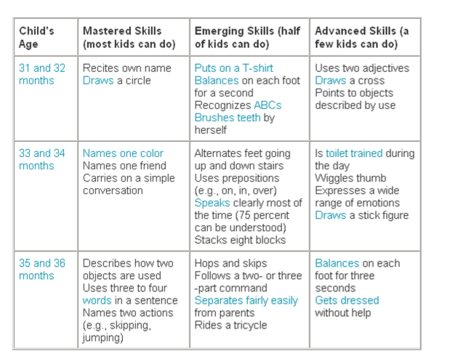
The typical 24-month-old knows about 50 to 75 words and is working the next big milestone: stringing them together into phrases and sentences. Two-word noun-verb sentences are typical at 2: "baby sleep" and "want milk." He'll probably begin expressing himself in longer sentences as the year goes by. If your child uses fewer than 20 words, he should be tested for hearing problems.
First sentences tend to be short (two to three words) and to the point: "Mommy help." "Play ball Daddy." Or a preschooler may echo a group of words she hears often, like "Go bye-bye" or "All gone."
Some ways to encourage your 2-year-old to speak in sentences:
Your life now
If you're feeling like the clutter around your house is growing right along with your child, you're not alone. Not only do preschoolers continue to acquire toys at an alarming rate, but more and more they — blocks, puzzles, car collections — come with multiple parts, which preschoolers love to dump out and mix up. Individual bins for each type of toy help keep things organized. (Empty diaper-wipe boxes are an inexpensive way to keep track of smaller parts.) Save yourself clean-up time by putting out only one or two bins of toys at a time. This keeps the toys more interesting — and the floor tidier, too.

